

Table of Contents
- Why Hypoallergenic Makeup Brushes Matter for Sensitive Skin
- Synthetic vs Natural Makeup Brushes: Which Is Safer?
- What to Look For When Buying Hypoallergenic Makeup Brushes
- Signs of Makeup Brush Allergy and How to Troubleshoot
- How to Clean Makeup Brushes for Sensitive Skin
- Artist Atelier's Recommended Brushes for Sensitive Skin
- Building a Minimal Kit: Which Brushes You Actually Need
- Conclusion
Last Updated: August 16, 2026
Why Hypoallergenic Makeup Brushes Matter for Sensitive Skin
Hypoallergenic makeup brushes are designed to minimise allergic reactions, irritation, and inflammation during makeup application. For reactive or delicate complexions, the wrong brush can trigger redness, itching, or a compromised skin barrier as readily as the wrong product. Irritation from brushes is almost always preventable once you understand what causes it: bristle material, hygiene habits, and overlooked chemical finishes.
Common Causes of Makeup Brush Irritation
Most brush-related irritation falls into three categories: bristle material, accumulated residue and bacterial growth, or chemical finishes on the handle and ferrule.
Natural animal-hair bristles are porous, trapping oils, product residue, and bacteria between uses. For sensitive skin, this creates low-grade irritation often mistakenly attributed to foundation or moisturiser. Synthetic bristles have a non-porous structure that resists bacterial growth and is far easier to deep-clean.
Chemical irritants are the second culprit. Many mass-market brushes carry formaldehyde-based preservatives, artificial dyes, or fragrance compounds in the bristle coating. Fragrance-free finishes and latex-free ferrule adhesives should be non-negotiable for reactive skin.
The third cause is infrequent cleaning. Makeup residue left on bristles oxidises, and the resulting bacterial load can cause breakouts and contact dermatitis even on originally gentle brushes.
How Bristle Material Affects the Skin Barrier
The skin barrier is the outermost layer of the epidermis, responsible for retaining moisture and blocking environmental aggressors. Repeated mechanical friction from stiff or coarse bristles can disrupt this barrier, leading to transepidermal water loss and increased sensitivity over time.
Ultra-soft synthetic fibers, particularly taklon and nylon variants, exert significantly less mechanical stress on the skin surface than stiffer natural-hair alternatives. Quality synthetic bristles are tapered at the tip, mimicking natural hair without the cuticle layer that causes drag. This translates to a gentler touch during blending and reduced risk of micro-abrasion on reactive skin.
Synthetic vs Natural Makeup Brushes: Which Is Safer?
For sensitive skin, synthetic bristles are the clear choice. Natural hair brushes, including those made from squirrel, goat, or sable, carry inherent risks for reactive complexions that synthetic alternatives do not.
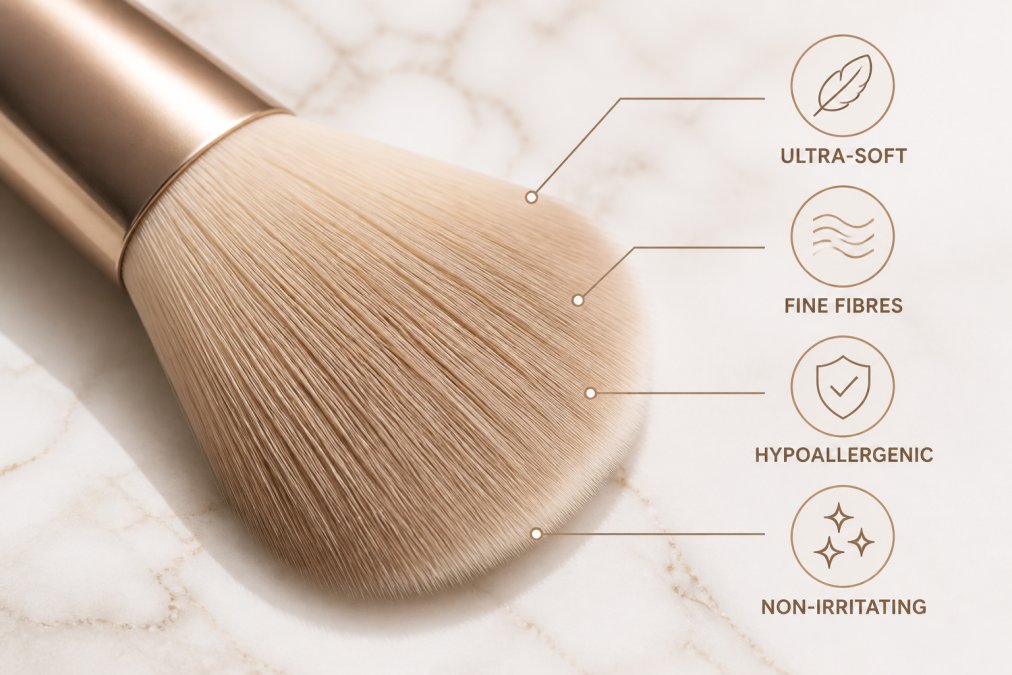
Why Synthetic Bristles Win for Reactive Skin
Natural bristles are structurally porous. Under a microscope, each strand has a cuticle layer with microscopic scales that catch and hold makeup residue, skin oils, and bacteria. For someone with a compromised skin barrier, applying a brush carrying that bacterial load is a reliable route to inflammation.
Synthetic bristles, made from taklon or nylon fibers, are non-porous. Bacteria and makeup residue sit on the surface rather than being absorbed, so thorough cleaning removes the vast majority of contamination. Synthetic fibers are also inherently cruelty-free.
Modern synthetic fibers are engineered with tapered tips and varying bristle density to deliver flawless finishes with liquid, cream, and powder formulas. The idea that synthetic brushes cannot match natural hair for blending is outdated.
According to the British Skin Foundation's guidance on contact dermatitis, animal-derived materials are a recognised trigger for allergic contact reactions in people with pre-existing skin sensitivities.
Material Safety and What to Look For on the Label
Dermatological safety in makeup brushes is not regulated like cosmetic products. Under the UK Cosmetic Products Regulation enforced by the Office for Product Safety and Standards, brushes are classified as accessories, meaning manufacturers face fewer mandatory disclosure requirements.
Look for these indicators when assessing a brush's safety profile:
- Synthetic fiber declaration: The label should state taklon, nylon, or synthetic fiber explicitly
- Fragrance-free: No added fragrance in the bristle coating or handle finish
- Latex-free: The ferrule adhesive should not contain natural rubber latex
- Dermatologist-tested: Third-party testing, not just a marketing claim
- Anti-microbial fiber treatment: Some professional-grade brushes carry treated fibers that inhibit bacterial growth
What to Look For When Buying Hypoallergenic Makeup Brushes
The biggest mistake when shopping for hypoallergenic makeup brushes is prioritising aesthetics over material specification. A beautiful handle tells you nothing about how the brush will interact with sensitive skin.
Bristle Density and Brush Shape for a Gentle Touch
Bristle density describes how tightly packed the individual fibers are within the ferrule. Higher density creates more coverage but also more friction. For sensitive skin, medium-density is generally better: enough fiber to blend smoothly, but not so tightly packed that it drags across the face.
Brush shape matters too. Flat, paddle-shaped brushes apply more concentrated pressure than domed or tapered shapes. For foundation application on reactive skin, a slightly rounded or tapered head distributes pressure more evenly. Stippling brushes and duo-fiber heads, with sparse, feathered tips, are particularly gentle.
| Brush Shape | Best Use | Pressure on Skin | Recommended For Sensitive Skin |
|---|---|---|---|
| Flat paddle | Full-coverage foundation | High | No |
| Domed/rounded | Blending, powder | Medium | Yes |
| Tapered/pointed | Precise coverage | Low-medium | Yes |
| Stippling/duo-fiber | Sheer, buildable coverage | Very low | Yes (ideal) |
| Dense kabuki | Setting powder, bronzer | Medium | With light hand |
Handle Materials, Ferrule Quality and Fragrance-Free Finishes
The ferrule, the metal collar connecting bristles to handle, is a frequently overlooked source of irritation. Nickel-containing metal ferrules can cause contact dermatitis in people with nickel sensitivity, one of the most common contact allergies in the UK. Brushes with aluminium or nickel-free ferrules are safer.
Handle coatings are another consideration. Lacquered or heavily varnished handles sometimes carry solvent residues that transfer to the face. Unfinished wood, natural resin, or matte-coated handles are lower risk. Fragrance-free finishes on the handle are worth checking, particularly for anyone who applies brushes to the face and then touches their eyes.
Signs of Makeup Brush Allergy and How to Troubleshoot
A makeup brush allergy typically presents as redness, itching, or small raised bumps in areas where the brush makes contact with the skin. The reaction usually appears within 24 to 48 hours of use.
Signs of makeup brush allergy include:
- Persistent redness in specific zones of the face that clears when you stop using a particular brush
- Itching or burning sensation after application that does not resolve with moisturiser
- Small papules or vesicles in areas of brush contact
- Worsening skin texture despite consistent skincare
Reaction Troubleshooting: Isolating the Cause
The most reliable method for isolating a brush-related reaction is a structured elimination protocol. Stop using all brushes for five to seven days and observe whether symptoms resolve. If they do, reintroduce one brush at a time, using each on the inner forearm for three days before applying it to the face. This patch-test approach, recommended by the British Association of Dermatologists' patient information on patch testing, allows you to identify the specific tool causing the reaction.
If symptoms persist after switching to verified synthetic, fragrance-free, latex-free brushes, the reaction may be caused by the makeup product rather than the brush.
How to Clean Makeup Brushes for Sensitive Skin
Cleaning frequency is the single most neglected factor in brush hygiene for sensitive skin. A brush that was gentle when new becomes a source of irritation within two to three uses if not cleaned properly. Makeup residue, skin oils, and environmental debris accumulate rapidly, creating conditions that favour bacterial growth.
Deep Cleaning Protocol for Reactive Skin
A deep cleaning protocol should remove product residue, bacteria, and any residual cleanser that might itself cause irritation. Avoid alcohol-heavy brush cleansers, which can degrade synthetic fibers and leave drying residues. Fragrance-free, sulphate-free cleansers are safest.
Step-by-step deep cleaning method:
- Wet the bristles with lukewarm water, pointing the brush head downward
- Apply a small amount of fragrance-free, sulphate-free cleanser to a silicone cleaning pad or your palm
- Swirl the bristles gently in circular motions for 30 to 60 seconds
- Rinse thoroughly under lukewarm running water until water runs clear
- Gently reshape the bristle head with your fingers
- Lay flat on a clean towel to dry, bristles hanging slightly over the edge
Never dry brushes upright. Water migrates into the ferrule, loosening the adhesive and causing bristle shedding.
How Often to Clean and When to Replace
For sensitive skin, cleaning should be more frequent than general guidance suggests. Foundation and concealer brushes used daily should be cleaned every three to four days. Powder and setting brushes can be cleaned weekly. Spot-cleaning with fragrance-free micellar water between uses extends the interval without compromising hygiene.
Replace brushes when bristles shed consistently, the head has permanently lost its shape, bristles feel rough despite cleaning, or the ferrule shows visible corrosion.
Artist Atelier's Recommended Brushes for Sensitive Skin
Artist Atelier's brushes are handcrafted by master artisans in Seoul using ultra-soft, hypoallergenic synthetic materials, well-suited to reactive and delicate complexions. The collection is built around a minimal-kit philosophy: fewer, better tools that each perform multiple functions.
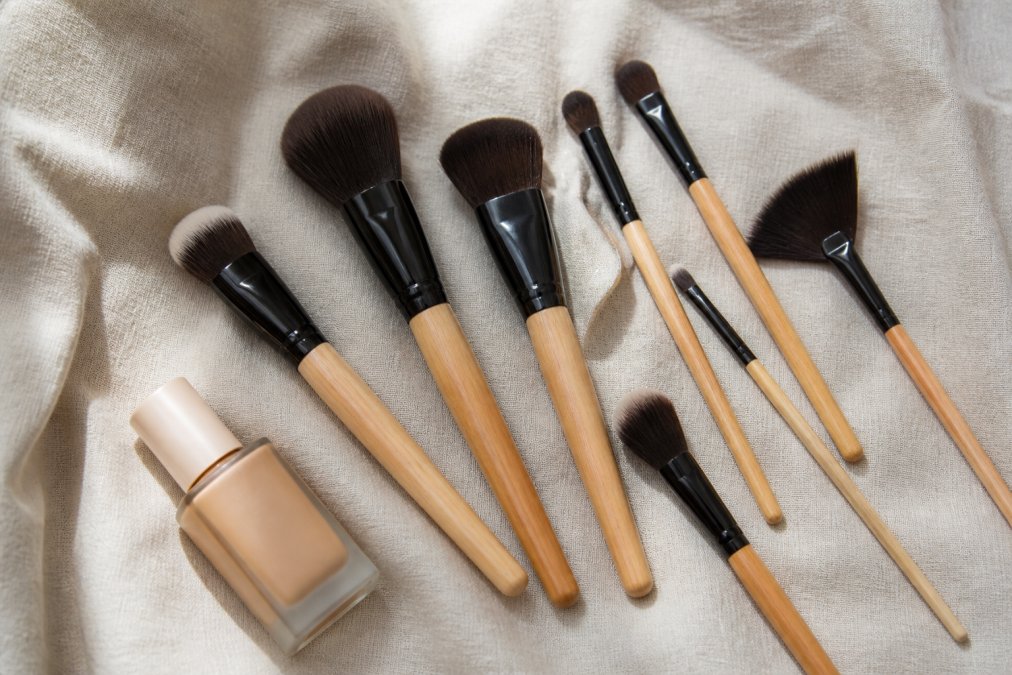
For foundation application, the Flawless Foundation Brush at £25 delivers seamless, full-coverage application with a warm, soft bristle head that minimises drag on reactive skin. The tapered shape distributes pressure evenly.

The Foundation Brush - Streak-Free Liquid & Cream Coverage at £14 offers a rounded angled head designed to follow the contours of the face, reducing localised pressure. For anyone new to hypoallergenic makeup brushes, this is a practical entry point.
For finishing and setting, the Kabuki Brush - Full-Face Powder & Bronzer Brush at £34 uses a wide domed head that distributes product across a large surface area with minimal friction per square centimetre.
The Midnight Crane Foundation Brush at £21 and The Birch at £25 both deliver professional-grade precision: full coverage with zero compromise on skin comfort.


Building a Minimal Kit: Which Brushes You Actually Need
The minimal-kit philosophy challenges the assumption that more brushes equals better results. For sensitive skin, fewer tools means fewer variables, simpler hygiene routines, and less cumulative friction on the skin surface.
A functional minimal kit for sensitive skin requires three brushes:
1. A foundation brush. This handles base application and can double as a concealer brush for larger areas. A medium-density, domed or tapered synthetic brush covers this function well.
2. A powder or kabuki brush. Setting powder, light bronzer, and blush can all be applied with a single well-chosen domed brush.
3. A small blending brush. For eye shadow, concealer detail work, and precise blending, a compact domed or tapered brush handles the task.
Three brushes, cleaned regularly, from verified hypoallergenic materials, will outperform a 24-piece set of poorly maintained, unverified tools. According to the Cosmetic, Toiletry and Perfumery Association's consumer guidance on cosmetic tool hygiene, maintaining a smaller, well-cleaned kit is one of the most effective ways to reduce the risk of skin reactions from makeup tools.
Choosing the right brushes for sensitive skin is genuinely difficult when most products offer no meaningful material disclosure. Artist Atelier's handcrafted, ultra-soft hypoallergenic makeup brushes are built with exactly this concern in mind: synthetic, fragrance-free materials, professional-grade fiber density, and a minimal-kit approach that simplifies both your routine and your hygiene practice. Add the Flawless Foundation Brush or the Kabuki Brush to your kit and experience the difference that verified, artisan-crafted tools make on reactive skin.
Frequently Asked Questions
Are synthetic bristles better for sensitive skin than natural hair?
Synthetic bristles made from taklon or nylon are generally better for sensitive skin. Unlike natural animal hair, synthetic fibres are non-porous, so they absorb less product and harbour far less bacterial growth between washes. They also contain no animal proteins or dander that can trigger an allergic reaction. For anyone with a delicate complexion or reactive skin, synthetic brushes are the safer, more hygienic choice and are also cruelty-free.
Is it possible to be allergic to makeup brushes?
Yes. Brushes made with natural animal hair can cause an allergic reaction due to proteins in the bristles. Even synthetic brushes can irritate if the ferrule contains nickel, the handle uses certain lacquers, or the brush retains makeup residue and bacteria from infrequent cleaning. Signs of a brush allergy include persistent redness, itching, or small raised bumps that appear specifically where the brush contacts the skin. Switching to hypoallergenic, fragrance-free, latex-free synthetic brushes usually resolves the issue.
How often should you replace makeup brushes to prevent skin irritation?
High-quality synthetic brushes used daily should be replaced roughly every one to two years, depending on how well they are maintained. Signs it is time to replace a brush include bristle shedding, a persistent smell even after deep cleaning, splayed fibres that no longer hold their shape, or recurrent skin irritation despite a thorough cleaning routine. Regular washing extends brush life significantly and reduces the bacterial growth that causes breakouts and irritation on sensitive skin.
What should I look for in hypoallergenic makeup brushes for sensitive skin?
Prioritise brushes with ultra-soft synthetic fibres such as taklon or nylon, as these are non-porous and resist bacterial growth. Check that the ferrule is nickel-free and that no adhesives or handle finishes contain fragrance or latex. Bristle density matters too: a densely packed brush deposits more product but can feel abrasive, while a lighter density gives a gentler touch for a flawless finish. Dermatologist-tested labelling and cruelty-free certification are useful indicators of dermatological safety.
How do I clean makeup brushes if I have sensitive skin?
Use a fragrance-free, sulphate-free brush cleanser or a mild unscented soap. Wet the bristles with lukewarm water, work a small amount of cleanser through the fibres, then rinse thoroughly until the water runs clear. Reshape the brush head and lay it flat or hang it bristle-down to dry completely before the next use. Deep clean every seven to ten days for brushes used on sensitive skin, and spot-clean liquid foundation brushes after every use to prevent makeup residue from building up.
What makeup do dermatologists recommend for sensitive skin?
Dermatologists generally recommend products labelled fragrance-free, hypoallergenic, and non-comedogenic, as these formulations are least likely to trigger skin irritation or clog pores. The same principles apply to brushes: dermatologist-tested synthetic tools with a gentle fibre structure are preferred over natural hair alternatives. Patch testing any new product or brush on a small area of skin before full use is standard advice for anyone with a reactive or delicate complexion.
This article was written using GrandRanker