

Table of Contents
- What Separates Luxury Makeup Brands from the Rest
- Professional Makeup Brush Sets: The Foundation of a Luxury Kit
- The Minimalist Makeup Kit Philosophy: Fewer Tools, Better Results
- Clean Luxe Skin Finish Techniques for a Radiant Complexion
- Luxury Makeup for Sensitive Skin: What to Look For
- Sustainability and Ethical Sourcing in Luxury Beauty
- How Professional Makeup Artists Choose Their Luxury Kits
- Frequently Asked Questions
Last Updated: September 12, 2026
What Separates Luxury Makeup Brands from the Rest
Luxury makeup brands earn their price tag through formulation density, pigment quality, and tool engineering. This guide from Artist Atelier examines what justifies the cost, and why a small collection of professional-grade tools outperforms a drawer full of compromise.
The gap between prestige and mass-market cosmetics rarely comes down to the logo. It comes down to what is inside the compact and on the end of the brush. High-end formulations carry higher concentrations of pigment and skin-loving ingredients, so you need less product for the same colour payoff.
Luxury makeup is defined less by brand prestige than by formulation integrity, pigment density, and tool quality. A luxury product should require less product, apply more evenly, and last longer than its mass-market counterpart.
High-End Formulations and Skin-Loving Ingredients
High-end formulations prioritise pigment load and skin compatibility over filler volume. Where budget cosmetics rely on talc and cheap binders, prestige formulas lean on treated pigments, emollients, and non-comedogenic bases, a functional difference for reactive skin.
Look for short ingredient lists with recognisable emollients and no heavy fragrance load. Dermatologist-tested and non-comedogenic claims are not tightly regulated, so treat them as a starting point, not a guarantee.
Cost-Per-Use: The Real Value of Luxury Makeup
Cost-per-use analysis reframes luxury makeup as an investment rather than an expense. Divide the price by the applications you expect: a foundation brush used five days a week for two years works out at pennies per use, while a cheap brush replaced every few months often costs more overall.

The calculation matters most for tools. A handcrafted brush holds its shape and bristle integrity far longer than a mass-produced alternative, so the effective daily cost drops with every use.
| Product Type | Typical Price | Expected Lifespan | Approx. Cost Per Use |
|---|---|---|---|
| Handcrafted foundation brush | £21-£25 | 2-3 years | Under 3p |
| Mass-market brush set | £15-£20 | 3-6 months | 10-15p |
| Luxury lip brush | £12 | 2+ years | Under 2p |
Professional Makeup Brush Sets: The Foundation of a Luxury Kit
Professional makeup brush sets are the backbone of any luxury routine because they determine how every product above them performs. A £60 foundation applied with a poor brush looks like a £6 foundation. The reverse is also true.
Artist Atelier builds its collection around this principle, with each brush handcrafted by master artisans in Seoul using ultra-soft, hypoallergenic materials. The Midnight Crane Foundation brush uses a 22mm flat head of high-grade artificial hair to glide foundation across the face in smooth, even strokes, building coverage that looks flawless rather than applied. The Birch uses a 25mm straight-cut square head that covers the face in deliberate, even strokes, pressing product into skin with a precision that buffs, smooths, and perfects.
Why Handcrafted Brushes Outperform Mass-Produced Alternatives
Handcrafted brushes outperform mass-produced alternatives because bristle density, cut shape, and ferrule construction are controlled individually rather than approximated across thousands of units, less shedding, better pickup, and a head shape that follows the face.
A common mistake is judging a brush by how soft it feels on the back of the hand. Softness matters, but so does spring. A brush needs enough tension to deposit pigment where you place it and enough give to diffuse the edges. Mass-produced brushes usually sacrifice one for the other.
The Minimalist Makeup Kit Philosophy: Fewer Tools, Better Results
The minimalist makeup kit philosophy replaces a crowded drawer with a few multi-use tools that each do one job exceptionally well. Fewer brushes means better hygiene, faster routines, and less decision fatigue.
Most guides get this wrong: they treat minimalism as a budget strategy when it is a performance strategy. A professional artist carrying five brushes is not cutting corners, they are removing redundancy.
A workable minimal kit looks like this:
- One foundation brush for base application
- One angled brush for blush, bronzer, and contour
- One powder brush for setting and finishing
- One lip brush for definition and blending
- One blending brush for the hairline and jaw
Artist Atelier's Angled Blush & Contour Brush was designed to make every face look professionally lit, with a precision-cut angled head that follows the cheekbone. The Squirrel Cheek & Hairline Brush combines squirrel hair, wool, and premium synthetic bristles in a single 7mm angled head, creating a tool that works harder than brushes twice its size.

Clean Luxe Skin Finish Techniques for a Radiant Complexion
A clean luxe skin finish depends on technique as much as product. The goal is skin that looks like skin, even, luminous, and never masked. That requires thin layers, the right tool for each texture, and patience between passes.
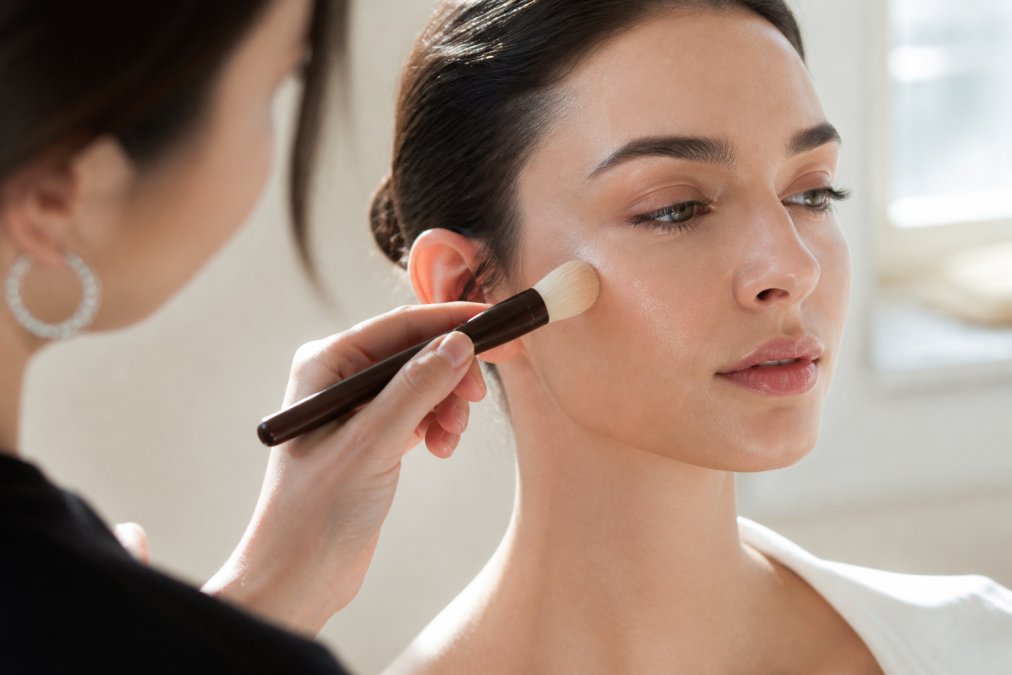
Start with a small amount of product and build. Press rather than sweep, especially around the nose and jaw. Set only where needed, typically the T-zone, and leave the high points of the cheeks bare so light can move across them.
Application Methods for Different Luxury Textures
Application method should change with texture. Liquid and serum foundations respond best to a flat, dense head that presses product in. Cream formulas need a spatula or angled shape to lay them flat before buffing. Powder needs a domed head with enough tension to distribute evenly without disturbing the base.
For powder placement, Artist Atelier's Kabuki Brush uses a wide domed head with premium synthetic bristles to cover the full face in smooth, even strokes that buff, blend, and set with a single sweep. The Blush Contour Powder brush uses a rounded 19mm head of premium fox hair for focused powder application.

Luxury Makeup for Sensitive Skin: What to Look For
Luxury makeup for sensitive skin should prioritise hypoallergenic materials, minimal fragrance and a short ingredient list. Reactive skin responds badly to rough bristles, harsh binders and heavy scent, so the tool matters as much as the formula. The practical test: can it be worn daily without triggering redness, itching or perioral dermatitis?
Ingredients Worth Seeking Out and Ingredients Worth Avoiding
A prestige formula earns its place on reactive skin when it swaps common irritants for better-tolerated alternatives. The table below sets out the trade-offs most practitioners look for.
| Ingredient type | Common in mass-market | Preferred in luxury | Why it matters for reactive skin |
|---|---|---|---|
| Bulking agent | Talc | Mica, boron nitride, silica | Talc can carry trace irritants and sits heavily; mica and boron nitride give a lighter, more breathable finish |
| Emollient | Mineral oil | Squalane, jojoba esters, shea butter | Plant and skin-identical emollients are less likely to clog pores |
| Preservative | Parabens, formaldehyde releasers | Phenoxyethanol, sodium benzoate | Lower sensitisation risk for most users |
| Fragrance | Synthetic parfum | Fragrance-free or essential-oil-free | Fragrance is the single most common cause of cosmetic contact allergy (the NHS) |
| Colourant | Uncoated pigments | Amino-acid-treated pigments | Treated pigments sit on the surface rather than binding to skin |
In the UK, cosmetics must comply with the Cosmetics Regulation, which requires a safety assessment and a full ingredient list on the packaging (gov.uk). "Hypoallergenic", "dermatologist-tested" and "non-comedogenic" are marketing terms rather than regulated claims, so check the INCI list yourself, and patch-test on the inner forearm for 48 hours if you have a diagnosed allergy.
Matching Tools to Skin Type
Skin type changes which tool works best, not just which formula.
- Dry or dehydrated skin benefits from a dense, flat foundation brush that presses emollient product into the skin without dragging. Buffing too vigorously disturbs the barrier and causes flaking.
- Oily skin responds to a domed powder brush with enough tension to set without over-powdering. A light hand is more important than the tool itself.
- Combination skin is best served by two tools: a flat head for the drier cheeks and a smaller rounded head for the T-zone.
- Reactive or rosacea-prone skin needs the softest bristles available and a gentle press-and-roll motion rather than sweeping, which reduces friction and flushing.
Bristle Material, Dye and Construction
When assessing a brush, check three things: bristle material, dye use and how the bristles are cut. Natural hair blends can be beautifully soft but vary batch to batch, while high-grade synthetic bristles are consistently smooth and easier to clean. Undyed bristles remove one more potential irritant, and handcrafted construction reduces the shedding that irritates skin during application.
If you have reacted to brushes before, the issue is often residual product trapped deep in the head rather than the bristle itself. Wash synthetics weekly with mild soap, reshape the head and dry it bristle-down so water does not seep into the ferrule.
Sustainability and Ethical Sourcing in Luxury Beauty
Sustainability in luxury beauty comes down to longevity, material choice and end of life. A tool that lasts three years and is used daily has a far lower environmental cost than three cheap replacements, even before you account for the materials inside it.
The Cost-Per-Use Argument, Extended to Carbon
The same maths that justifies a £21 brush on cost per use also justifies it on materials. A handcrafted brush that survives three years of daily use displaces roughly six to twelve mass-market replacements, each carrying its own manufacturing, packaging and shipping footprint. The most sustainable purchase is usually the one you do not have to repeat.
What to Look For on the Label
Several schemes give you a verifiable signal rather than a vague claim:
- Cruelty Free International Leaping Bunny, the most rigorous UK-recognised cruelty-free certification, requiring independent audit of the supply chain.
- Vegan Society trademark, confirms no animal-derived ingredients, which matters for natural-hair brushes and for carmine, beeswax and lanolin in formulas.
- FSC-certified wood or bamboo handles, evidence the timber comes from responsibly managed forests.
- Refillable or replaceable components, a compact or palette where the pan can be swapped out avoids throwing away the casing.
- Recycled aluminium ferrules and post-consumer packaging, reduces virgin material demand.
Beware of "clean", "green" and "natural" as standalone claims (asa.org.uk). None is defined in UK consumer law, and a natural ingredient can be more sensitising than a synthetic one.
The Natural-Hair Trade-Off
Natural hair brushes, squirrel, goat, sable, fox, are prized for how they pick up and diffuse powder, but raise an ethical question that synthetics avoid. If animal welfare is a priority, high-grade synthetic bristles now match natural hair for powder pickup and exceed it for cream and liquid formulas, and they are easier to clean. The trade-off is a slightly different feel.
End of Life: Cleaning, Repair and Disposal
A luxury brush should be treated as repairable, not disposable. Most handles and ferrules can be re-set if the head loosens. At end of life:
- Separate the head from the handle where possible.
- Check whether the handle material is accepted in your local council's recycling stream, wooden handles usually are not, but aluminium ferrules often are.
- Do not put bristles in the recycling bin; they belong in general waste.
For formulas, decant the last of a foundation into a smaller jar rather than binning the bottle, and check whether your local authority runs a cosmetic packaging take-back scheme or a retailer offers in-store collection for empties.
How Professional Makeup Artists Choose Their Luxury Kits
Professional makeup artists choose tools the way a chef chooses knives: by balance, edge retention, and how the tool behaves under pressure. They buy fewer pieces and expect each to perform across multiple formulas and skin types.
The Artist Atelier workshop programme reflects this, teaching technique, hygiene, and the minimal-kit philosophy to professionals and serious hobbyists, with certification provided. You do not need to work in the industry to benefit, but you do need to be willing to unlearn habits built around cheap tools.
Building a luxury makeup collection is less about accumulating products and more about choosing tools that make every product perform better. Artist Atelier handcrafts each brush in Seoul using ultra-soft, hypoallergenic materials, and backs the collection with professional-led workshops covering technique, hygiene, and the minimal-kit philosophy. Start with a foundation brush, add one angled multi-use tool, and build from there. Get started with Artist Atelier and see how much difference the right tools make to your daily routine.
Frequently Asked Questions
What makes a makeup brand considered luxury?
A luxury makeup brand is defined by several factors: high-end formulations with premium pigments, artisanal craftsmanship, and a focus on performance over mass production. It also involves the quality of tools, such as handcrafted brushes made from hypoallergenic materials. Luxury brands often invest in skin-loving ingredients and provide a refined experience, from packaging to application. The result is a product that not only performs but also feels considered and delivers a flawless, long-wear finish.
Are luxury makeup brands actually better than drugstore alternatives?
Luxury makeup brands often use higher concentrations of pigment and more refined ingredients, which can lead to better blendability, longer wear, and a more natural finish. The tools are also a major differentiator: professional-grade brushes, like those handcrafted in Seoul, are designed for precision and are often hypoallergenic, making them suitable for sensitive skin. While drugstore options can work, luxury products typically offer superior performance and durability, making them a worthwhile investment for enthusiasts.
Which luxury makeup brands are best for sensitive skin?
For sensitive skin, look for brands that prioritise hypoallergenic materials and non-comedogenic formulas. Luxury brands that focus on clean ingredients and avoid common irritants are ideal. When it comes to tools, brushes made from ultra-soft synthetic or natural hairs, such as those from Artist Atelier, are handcrafted to be gentle on the skin. They minimise friction and redness, allowing you to apply makeup without triggering irritation. Always patch-test new products and check for dermatologist-tested claims.
How do professional makeup artists choose their luxury kits?
Professional makeup artists select luxury kits based on performance, versatility, and reliability. They prioritise tools that offer precise application and are durable enough for daily use. A minimal-kit philosophy is common, where each brush serves multiple purposes, such as a foundation brush that can also blend concealer. Artists also value hygiene and ease of cleaning. Brands that provide certification or training, like Artist Atelier's workshops, are favoured because they ensure artists understand the techniques needed to maximise the tools' potential.