

Table of Contents
- What Defines a Professional Makeup Kit?
- Step 1: Choose Your Kit's Foundation Range and Base Products
- Step 2: Select the Best Makeup Brush Sets for Professionals
- Step 3: Understand Makeup Artist Hygiene Regulations UK
- Step 4: Build a Minimalist Makeup Kit for Freelance Artists
- Step 5: Organise, Maintain, and Track Your Kit's Inventory
- Conclusion: Your Professional Kit, Refined
- Frequently Asked Questions
Last Updated: September 9, 2026
A professional makeup kit is a curated collection of products and tools that allows an artist to execute any brief with consistency, speed, and impeccable hygiene standards. Building one is less about buying everything at once and more about understanding a system of coverage, sanitation, and versatility. At Artist Atelier, a professional makeup kit is defined by intention, not volume.
Most aspiring artists purchase a massive set of cheap brushes and a rainbow of rarely-used shadows before mastering the base, resulting in a heavy, disorganised bag and products that expire before they are ever opened. Below, we’ll show you exactly how to build a professional makeup kit that is lean, compliant, and tailored to the work you actually want to book.
What Defines a Professional Makeup Kit?
A professional makeup kit is distinguished from a personal stash by three factors: the range of skin tones it accommodates, the hygiene protocols it supports, and the durability of its tools. It must include pro-grade palettes and disposables to prevent cross-contamination, ensuring you can move from one client to the next without compromise.
Many artists now prioritise synthetic brushes and refillable palettes to reduce waste while maintaining high-pigment results. Owning fewer, higher-quality items reduces your environmental footprint and forces you to master versatility. A common approach is to start with a core of 10-15 brushes and 5-6 base products rather than 50 impulse purchases.
Step 1: Choose Your Kit's Foundation Range and Base Products
Your foundation range is the backbone of your entire kit. To cater to the majority of clients, you need a selection that covers different undertones, warm, cool, and neutral, across a spectrum of shades. Rather than buying every shade a brand offers, a professional makeup kit typically includes a mixing palette and a foundation range that can be blended to match exact skin tones.
When selecting bases, focus on formulation versatility. A buildable, medium-coverage foundation can be sheered out with moisturiser for a natural look or layered for full glam. Pair this with a concealer palette that offers colour correction options for redness and dark circles. For seamless application, the The Birch foundation brush from Artist Atelier is the tool professionals reach for when coverage needs to be fast and undetectable; its 25mm straight-cut square head presses product into the skin for a buffed, airbrushed finish.

Step 2: Select the Best Makeup Brush Sets for Professionals
The best makeup brush sets for professionals are not necessarily the largest ones; they are the sets that offer distinct shapes for specific functions without redundancy. Synthetic brushes are ideal for foundation and concealer because they do not absorb product, while natural hair brushes, such as pony or squirrel hair, are superior for blending powders and eyeshadows due to their ability to pick up and diffuse pigment effectively.
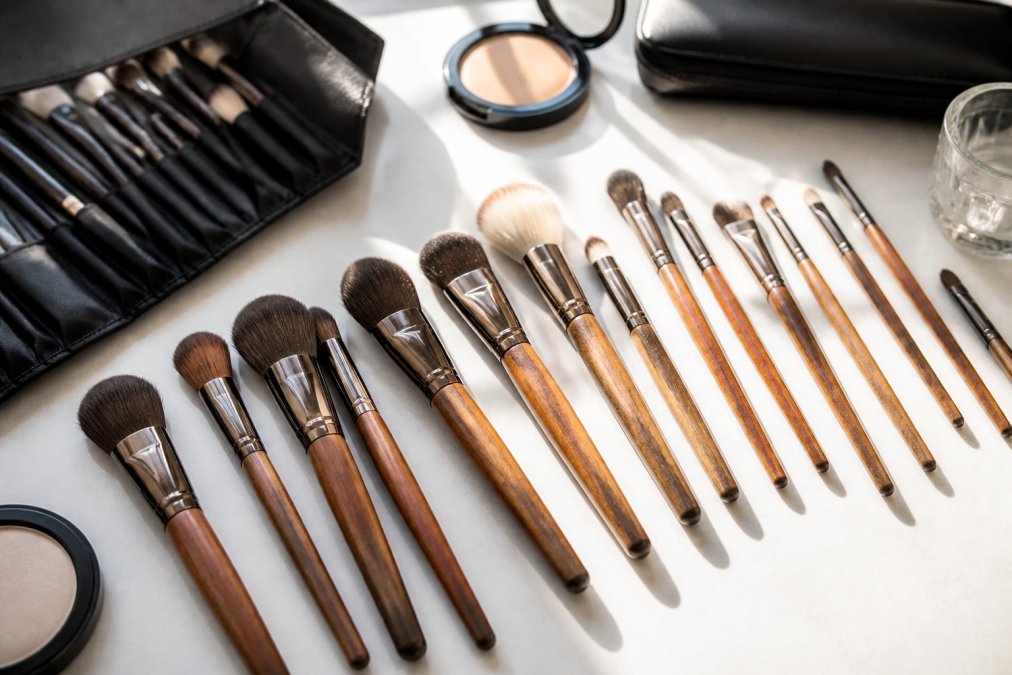
A complete kit does not require twenty brushes. You can achieve nearly every look with a core set of five: a foundation brush, a fluffy powder brush, an angled concealer brush, a flat shader, and a blending brush. For setting powder and bronzer, the Kabuki Brush offers a wide domed head that covers the full face in smooth, even strokes, while the Powder Brush provides the precision needed for a natural flush of colour.


Essential Brushes for a Complete Kit
The essential tools for a working artist include a flat, dense brush for packing pigment onto the lid, such as the Shadow Moth Eyeshadow Brush, which uses pony hair to deliver rich intensity. For under-eye work and correction, an angled concealer brush is non-negotiable for drawing clean lines and covering blemishes without dragging the skin.
Professional artistry demands that brushes are cleaned between clients, which means you need a system for rapid sanitation. Cheap bristles degrade quickly with frequent washing, whereas handcrafted, ultra-soft materials maintain their shape and performance over time. Artist Atelier brushes are meticulously handcrafted and designed to withstand the rigours of daily professional use, making them a sound kit investment.
Step 3: Understand Makeup Artist Hygiene Regulations UK
Working as a professional in the UK means adhering to strict makeup artist hygiene regulations UK standards, enforced to protect clients from infections and skin reactions. While there is no single national licence, you are expected to follow guidelines set by local authorities and industry bodies, which mandate the use of disposables for mascara wands and lip products, and the sanitation of brushes between clients (gov.uk).
To meet these regulations, your professional makeup kit must include a supply of disposables: spatulas for scooping creams, mascara wands, lip brushes, and mixing palettes. Never dip a used brush directly into a client's product pot. Instead, transfer product to a mixing palette using a clean spatula. For brush cleaning between clients, a fast-drying sanitiser spray is essential, followed by a deep clean with brush shampoo at the end of the day. For specific legal requirements regarding hygiene and insurance, consult your local council or professional trade associations.
Step 4: Build a Minimalist Makeup Kit for Freelance Artists
A minimalist makeup kit for freelance artists is a strategic response to the realities of travel and time constraints. When working on location, kit weight and travel-friendly organisation are paramount. The goal is to carry only what you need for the specific job, so build a core kit and add specialty items per booking.
Start with your base kit: one foundation range, one concealer palette, a setting powder, a brow product, a neutral eyeshadow palette, and your essential brushes. This covers 80% of typical freelance work, from corporate headshots to bridal trials. For niche work, such as editorial or special effects, add specific items like SFX supplies or high-fashion pigments.
However, a truly professional kit is not just minimal, it is niche-specific. The same core kit will not serve a bridal artist and an editorial artist equally well. Here is how the minimal-kit philosophy shifts across three common career paths:
Bridal kit. Bridal work demands longevity, flash-photography compatibility, and tear-proof performance. Your kit should prioritise long-wear, water-resistant formulas, a broader range of concealer shades, and setting sprays that lock makeup for 12+ hours. You will also need a dedicated bridal touch-up pouch with blotting papers, a mini setting powder, and a spare lip product for the bride's emergency kit. A common pattern among bridal artists is to carry two foundation formulas, one luminous for dry skin, one matte for oily skin, rather than a wide shade range.
Editorial and campaign kit. Editorial work is about texture, colour, and photographic effect rather than longevity. Your kit should include a wider range of cream and powder pigments, unusual textures (glosses, foils, metallic creams), and tools for precise, graphic application. You will rarely need a full foundation range; instead, carry a few high-coverage concealers and a mixing medium to create custom textures.
Special effects (SFX) kit. SFX work is a separate discipline entirely. Your kit will include prosthetics, adhesives, blood gels, scar wax, and colour palettes for bruising and ageing, none of which overlap with a standard beauty kit. Carry a small beauty kit for the actor's base skin preparation, and a separate, clearly labelled SFX case for effects supplies. Cross-contamination between beauty products and SFX materials is a hygiene risk, so the two kits should never share tools or spatulas.
For artists who work across multiple niches, maintain a core kit (the 80% base) and two niche pods, a bridal pod and an editorial pod, that you swap in and out of your main case depending on the booking.
Step 5: Organise, Maintain, and Track Your Kit's Inventory
Kit organisation is the difference between a calm, professional artist and a chaotic one. Invest in a sturdy, compartmentalised case that protects your products and allows for easy visual inventory. Use clear pouches or labelled palettes to group items by category: base, eyes, lips, and tools. This speeds up your workflow and signals professionalism to your clients.
Most working artists adopt a permanent inventory log, a spreadsheet, a notes app, or a dedicated inventory app, that records four fields for every product: purchase date, opening date, PAO (period after opening) symbol, and batch number. The PAO symbol, printed on the product label, tells you how many months a product remains safe after first opening (e.g., 6M, 12M, 24M) (europa.eu). Logging the opening date next to the PAO gives you a hard expiry date you can check before every booking.
For products without a PAO symbol, common with pro-grade palettes purchased as refill pans, label the pan with a permanent marker noting the month and year of first use. Cream products, mascaras, and liquid lipsticks typically last 6-12 months after opening; powder products can last 24-36 months if stored dry and away from direct sunlight. When in doubt, replace: using expired products on a client is a hygiene and reputational risk.
Beyond expiry, inventory tracking helps you manage stock rotation and reordering. A simple stock-count column in your log, noting whether you have a backup of a core foundation shade or a spare mascara wand, prevents mid-booking emergencies. Many artists also photograph their kit layout after each deep clean; this visual reference speeds up re-packing.
A monthly kit audit should take no more than 30 minutes. Empty the case, wipe down all surfaces with a sanitiser spray, check every product against your inventory log, and remove anything you have not used in three months. High-quality brushes can last for years if maintained, but they should be replaced when bristles begin to splay or shed, as this affects application and hygiene.
For artists working across multiple kits, a bridal kit, an editorial kit, and a teaching kit, a colour-coded labelling system (e.g., red dot for bridal, blue dot for editorial) on each product pan or pouch prevents cross-kit confusion. This level of organisation is what separates a professional kit from a personal stash: it is a system, not a collection.
Conclusion: Your Professional Kit, Refined
Building your kit is a continuous process of refinement. The challenge is resisting the urge to over-buy and instead focusing on the quality of your tools and the versatility of your products. A professional makeup kit is an investment in your career, and choosing handcrafted, hypoallergenic tools that support a minimal-kit philosophy will elevate your work and protect your clients' skin.
Get started with Artist Atelier and build a kit that reflects your commitment to technique, hygiene, and professional artistry. Add our ultra-soft, hypoallergenic brushes to your collection and experience the seamless application that comes from tools designed by master artisans.
Frequently Asked Questions
How much does a full professional makeup kit cost?
A full professional makeup kit can cost anywhere from £500 to over £2,000, depending on the brands you choose and the range of products. A minimalist kit, built around multifunctional products and a select set of high-quality brushes, can be a more affordable starting point. Investing in durable, professional-grade brushes, like those from Artist Atelier, ensures longevity, making them a more cost-effective choice than replacing cheaper brushes frequently.
What is the difference between a consumer and a professional makeup kit?
A consumer kit usually contains single-use products for personal application. A professional makeup kit is designed for versatility and hygiene. It includes a broad foundation range to match different client skin types and undertones, pro-grade palettes for eyeshadows and concealers, and tools like a mixing palette and spatula. Crucially, professional kits must include disposables and sanitation protocols to prevent cross-contamination between clients, adhering to makeup artist hygiene regulations UK.
How do I maintain and sanitise my professional makeup tools?
Daily sanitation involves using a brush spray to quickly disinfect brushes between clients. For a deeper clean, wash brushes weekly with a gentle cleanser, reshape them, and allow them to dry flat. Always use disposables like mascara wands and lip brushes, and decant cream products onto a mixing palette with a spatula. This prevents cross-contamination and maintains hygiene standards, extending the life of your kit.
What is the 2/3 rule for makeup?
The 2/3 rule is a technique for choosing foundation shades. It suggests that the correct foundation match is found by testing shades on the middle third of the face, from the forehead to the nose. This area reflects the skin's true undertone and texture better than the jawline or wrist, helping you select a shade that blends seamlessly and avoids a visible line.
What are the essential hygiene standards for a professional makeup kit?
Essential hygiene standards include using clean, sanitised brushes for each client, washing hands before application, and using disposables for mascara and lip products. Cream products should be dispensed onto a mixing palette to avoid contaminating the original container. You must also regularly wash your brushes with a specialist cleanser. These practices are central to makeup artist hygiene regulations UK and protect both you and your clients.